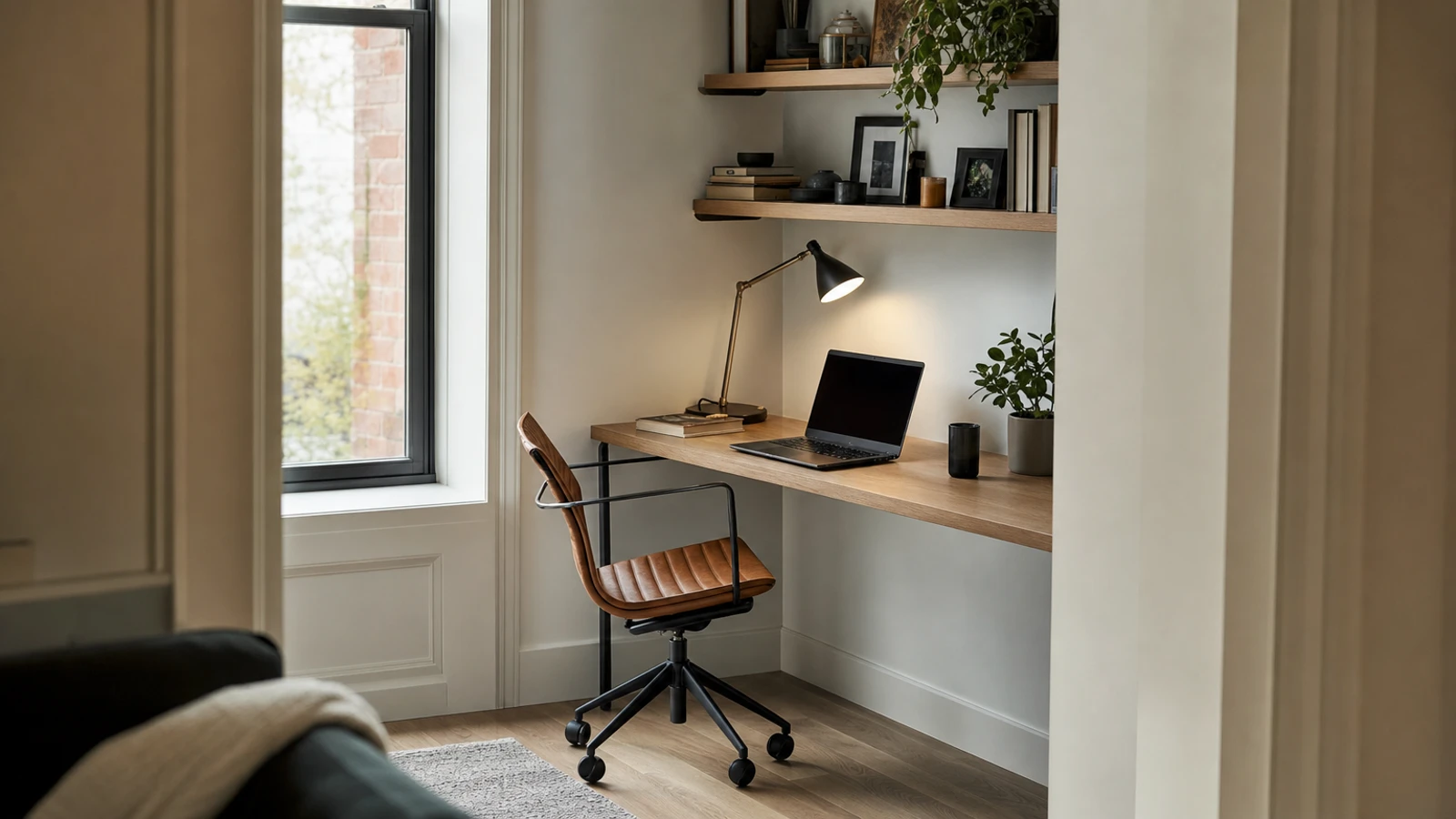
This support page focuses on space-saving office desk buying checklist for space-saving office desks. Product comparisons belong on the main shortlist, while this page stays focused on setup decisions and daily small-room fit.
Space-Saving Office Desk Buying Checklist
Footprint first. A space-saving office desk should be chosen by measuring the room before comparing style. Wall clearance, chair pull-out space, door swings, outlets, and walking paths decide whether a narrow desk actually feels useful. For space-saving office desk buying checklist, imagine a full workday in the exact room: opening the laptop, writing notes, joining calls, managing cables, standing up, and clearing the surface at night.
Measure the desktop width, depth, height, storage projection, chair clearance, wall distance, outlet access, and path around the workstation. Space saving is not just small size; it is how cleanly the desk fits into a real room without making work feel temporary.
Surface discipline. Compact desks work best when the surface supports the real routine: laptop, monitor, notebook, lamp, keyboard, mouse, and a small landing zone. Too little depth can make the setup feel cramped even if the desk looks elegant online. For space-saving office desk buying checklist, imagine a full workday in the exact room: opening the laptop, writing notes, joining calls, managing cables, standing up, and clearing the surface at night.
Measure the desktop width, depth, height, storage projection, chair clearance, wall distance, outlet access, and path around the workstation. Space saving is not just small size; it is how cleanly the desk fits into a real room without making work feel temporary.
Storage balance. Drawers, shelves, risers, pegboards, and cable trays help small desks stay calm, but too much built-in storage can make a tiny workstation bulky. The right choice hides daily clutter without stealing leg room. For space-saving office desk buying checklist, imagine a full workday in the exact room: opening the laptop, writing notes, joining calls, managing cables, standing up, and clearing the surface at night.
Measure the desktop width, depth, height, storage projection, chair clearance, wall distance, outlet access, and path around the workstation. Space saving is not just small size; it is how cleanly the desk fits into a real room without making work feel temporary.
Ergonomic reality. A compact desk still needs comfortable screen height, keyboard position, elbow angle, chair clearance, and foot placement. Small-space furniture should not force the user into hunched shoulders or twisted posture. For space-saving office desk buying checklist, imagine a full workday in the exact room: opening the laptop, writing notes, joining calls, managing cables, standing up, and clearing the surface at night.
Measure the desktop width, depth, height, storage projection, chair clearance, wall distance, outlet access, and path around the workstation. Space saving is not just small size; it is how cleanly the desk fits into a real room without making work feel temporary.
Stability and materials. Lightweight desks are easy to move, but the frame should not wobble when typing, writing, or leaning on the front edge. Check wall anchors, leg design, desktop thickness, caster locks, and weight limits. For space-saving office desk buying checklist, imagine a full workday in the exact room: opening the laptop, writing notes, joining calls, managing cables, standing up, and clearing the surface at night.
Measure the desktop width, depth, height, storage projection, chair clearance, wall distance, outlet access, and path around the workstation. Space saving is not just small size; it is how cleanly the desk fits into a real room without making work feel temporary.
Buyer caution. This guide does not claim hands-on testing. Always confirm current dimensions, mounting requirements, return terms, material descriptions, warranty language, and product photos before choosing a desk. For space-saving office desk buying checklist, imagine a full workday in the exact room: opening the laptop, writing notes, joining calls, managing cables, standing up, and clearing the surface at night.
Measure the desktop width, depth, height, storage projection, chair clearance, wall distance, outlet access, and path around the workstation. Space saving is not just small size; it is how cleanly the desk fits into a real room without making work feel temporary.
Footprint first. A space-saving office desk should be chosen by measuring the room before comparing style. Wall clearance, chair pull-out space, door swings, outlets, and walking paths decide whether a narrow desk actually feels useful. For practical checklist for space-saving office desk buying checklist, imagine a full workday in the exact room: opening the laptop, writing notes, joining calls, managing cables, standing up, and clearing the surface at night.
Measure the desktop width, depth, height, storage projection, chair clearance, wall distance, outlet access, and path around the workstation. Space saving is not just small size; it is how cleanly the desk fits into a real room without making work feel temporary.
Surface discipline. Compact desks work best when the surface supports the real routine: laptop, monitor, notebook, lamp, keyboard, mouse, and a small landing zone. Too little depth can make the setup feel cramped even if the desk looks elegant online. For practical checklist for space-saving office desk buying checklist, imagine a full workday in the exact room: opening the laptop, writing notes, joining calls, managing cables, standing up, and clearing the surface at night.
Measure the desktop width, depth, height, storage projection, chair clearance, wall distance, outlet access, and path around the workstation. Space saving is not just small size; it is how cleanly the desk fits into a real room without making work feel temporary.
Storage balance. Drawers, shelves, risers, pegboards, and cable trays help small desks stay calm, but too much built-in storage can make a tiny workstation bulky. The right choice hides daily clutter without stealing leg room. For practical checklist for space-saving office desk buying checklist, imagine a full workday in the exact room: opening the laptop, writing notes, joining calls, managing cables, standing up, and clearing the surface at night.
Measure the desktop width, depth, height, storage projection, chair clearance, wall distance, outlet access, and path around the workstation. Space saving is not just small size; it is how cleanly the desk fits into a real room without making work feel temporary.
Ergonomic reality. A compact desk still needs comfortable screen height, keyboard position, elbow angle, chair clearance, and foot placement. Small-space furniture should not force the user into hunched shoulders or twisted posture. For practical checklist for space-saving office desk buying checklist, imagine a full workday in the exact room: opening the laptop, writing notes, joining calls, managing cables, standing up, and clearing the surface at night.
Measure the desktop width, depth, height, storage projection, chair clearance, wall distance, outlet access, and path around the workstation. Space saving is not just small size; it is how cleanly the desk fits into a real room without making work feel temporary.
Stability and materials. Lightweight desks are easy to move, but the frame should not wobble when typing, writing, or leaning on the front edge. Check wall anchors, leg design, desktop thickness, caster locks, and weight limits. For practical checklist for space-saving office desk buying checklist, imagine a full workday in the exact room: opening the laptop, writing notes, joining calls, managing cables, standing up, and clearing the surface at night.
Measure the desktop width, depth, height, storage projection, chair clearance, wall distance, outlet access, and path around the workstation. Space saving is not just small size; it is how cleanly the desk fits into a real room without making work feel temporary.
Buyer caution. This guide does not claim hands-on testing. Always confirm current dimensions, mounting requirements, return terms, material descriptions, warranty language, and product photos before choosing a desk. For practical checklist for space-saving office desk buying checklist, imagine a full workday in the exact room: opening the laptop, writing notes, joining calls, managing cables, standing up, and clearing the surface at night.
Measure the desktop width, depth, height, storage projection, chair clearance, wall distance, outlet access, and path around the workstation. Space saving is not just small size; it is how cleanly the desk fits into a real room without making work feel temporary.
Use the main hub and related support pages to compare compact workstation questions before choosing a desk.